
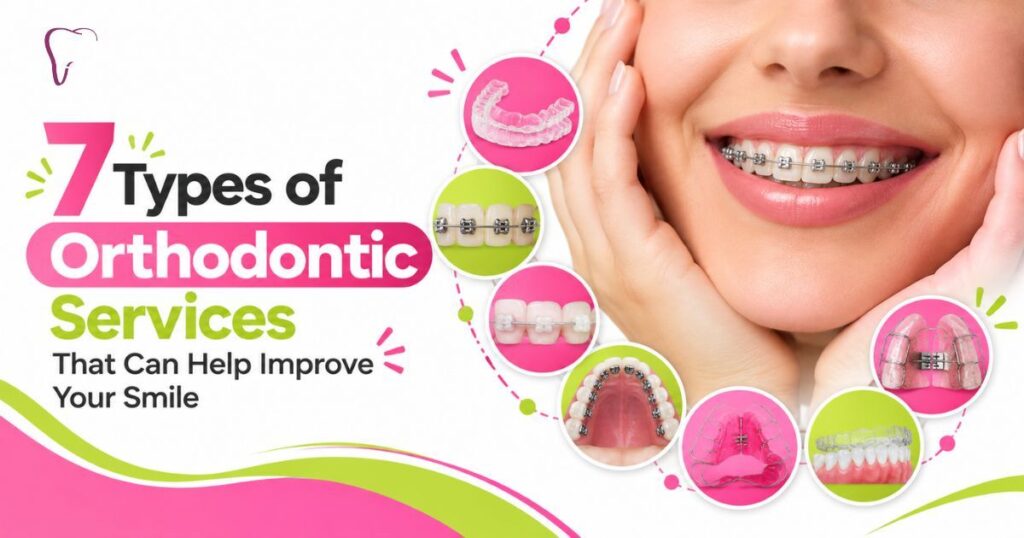
Most people researching orthodontic services have one picture in mind: a mouthful of metal. That picture is out of date. Modern orthodontics covers tooth-coloured brackets, braces hidden behind the teeth, aligners you take out for dinner, and treatments that guide a child’s jaw while it’s still growing.
The right choice depends on what’s wrong. Crowding, gaps, an overbite and a narrow upper jaw are different problems, and each one responds best to a different approach.
Here are seven options, what each one fixes, and who it suits.
Which Orthodontic Services Fix Which Problems?
1. Metal Braces: The Dependable Workhorse
Stainless steel brackets are bonded to each tooth and linked by a wire that the orthodontist adjusts at regular visits. They aren’t subtle. But they handle almost anything, from severe crowding to complex bite corrections.
For many teenagers, this remains the most practical form of braces treatment. Fixed brackets can’t be left on a bedside table or forgotten in a lunchbox, so progress doesn’t depend on daily discipline.
2. Ceramic Braces: Same Mechanics, Quieter Look
Ceramic braces move teeth the way metal ones do. Only the bracket material changes, and it’s tooth-coloured, so it blends in at normal speaking distance.
They suit adults and older teens who need the strength of fixed braces without drawing attention to them. The trade-off is maintenance. The clear elastics pick up stains from tea, coffee and turmeric-rich food, so brushing after meals matters more.
3. Lingual Braces: Hidden Behind the Teeth
Lingual braces are bonded to the inner surfaces of the teeth. Nobody sees them unless you open wide.
They demand more skill to fit and adjust, which is why fewer clinics offer them. Dr. Kunaal Agrawal holds a lingual orthodontics certification from Mumbai, so patients at Confi Dental Smile Clinic have this option available. Your tongue needs time to adjust, and some people notice a slight lisp at first.
4. Clear Aligners: Removable and Nearly Invisible
Each aligner is a thin plastic tray that moves the teeth a fraction further than the last. Clear aligners come out for eating and brushing, which makes cleaning easier than with fixed braces.
That freedom is also their weak point. They only work if you wear them for around 22 hours a day. The clinic is a certified Invisalign and Flash aligners provider and plans each case with digital intraoral scanning instead of impression trays.
5. Jaw Expansion: Making Room Before Straightening
Some crowding isn’t a tooth problem. The upper jaw is too narrow for the teeth it has to hold.
A palatal expander, fitted to the roof of the mouth, widens it gradually. It works best in children and young teens, while the jaw is still growing. A narrow upper jaw is also linked with crossbites and, in some cases, mouth breathing, so widening it does more than create space.
6. Early Interceptive Care for Children
The American Association of Orthodontists recommends a first orthodontic check by age seven. At that point, an orthodontist can spot a developing crossbite, crowding, or a habit such as thumb-sucking, and step in with simple appliances.
Early orthodontic treatments don’t always remove the need for braces later. They can, however, make the second phase shorter and simpler.
7. Retainers: The Step People Skip
Teeth have a memory. After braces or aligners come off, the fibres around each tooth keep pulling it towards its old position for months.
Retainers hold the result. Some are thin wires bonded behind the front teeth; others are removable clear trays. Skipping them is the most common reason straightened teeth drift, because good teeth alignment lasts only as long as the retention behind it.
Not Sure Which One Fits? Start With a Scan
No list can tell you which treatment your teeth need. An examination can.
At Confi Dental Smile Clinic in Chitragupt Nagar, Kotra Sultanabad, Bhopal, Dr. Kunaal Agrawal (MDS in Orthodontics and Dentofacial Orthopaedics) checks your bite, scans your teeth and explains which of these orthodontic services suits your case, your routine and your budget.
Book a consultation and leave with a clear plan before you commit to anything.
FAQs
Which orthodontic option is best for adults?
There’s no single best choice. Adults with mild or moderate crowding usually suit removable aligners, while complex bite problems tend to need fixed braces. Ceramic and lingual braces offer a discreet fixed option. A proper in-clinic assessment settles the decision.
Is there an age limit for braces?
No. Healthy teeth and gums matter far more than age. Children benefit from jaw-guiding treatment, teenagers most commonly wear braces, and adults straighten their teeth in their thirties, forties and beyond. Your orthodontist checks gum health before starting any treatment.
How long does orthodontic treatment take?
It depends mainly on how far the teeth need to move. Minor spacing corrections finish much sooner than complex bite cases. After examining and scanning your teeth, your orthodontist can give you a realistic, honest timeline for your specific case.
Do braces hurt?
Expect some mild soreness for a few days after fitting and after each adjustment. Soft foods and over-the-counter pain relief help with this. Brackets can rub the cheeks at first, and orthodontic wax eases that until the cheeks toughen up.
Why do I need a retainer after treatment?
The fibres holding your teeth in place keep pulling them towards their original positions after braces or aligners come off. A retainer holds everything steady while the surrounding bone and gums settle, protecting the result you’ve spent months working for.